
Solid Deutschland Meeting is happening 2021-01-12, 18:00 GMT+01 using jitsi software.
Joining Details short before at https://gitter.im/solid-germany/community
Solid Deutschland Meeting is happening 2021-01-12, 18:00 GMT+01 using jitsi software.
Joining Details short before at https://gitter.im/solid-germany/community
https://decentpatterns.xyz/virtual-workshop-cyan/
—-
this is thought to be a private reminder…
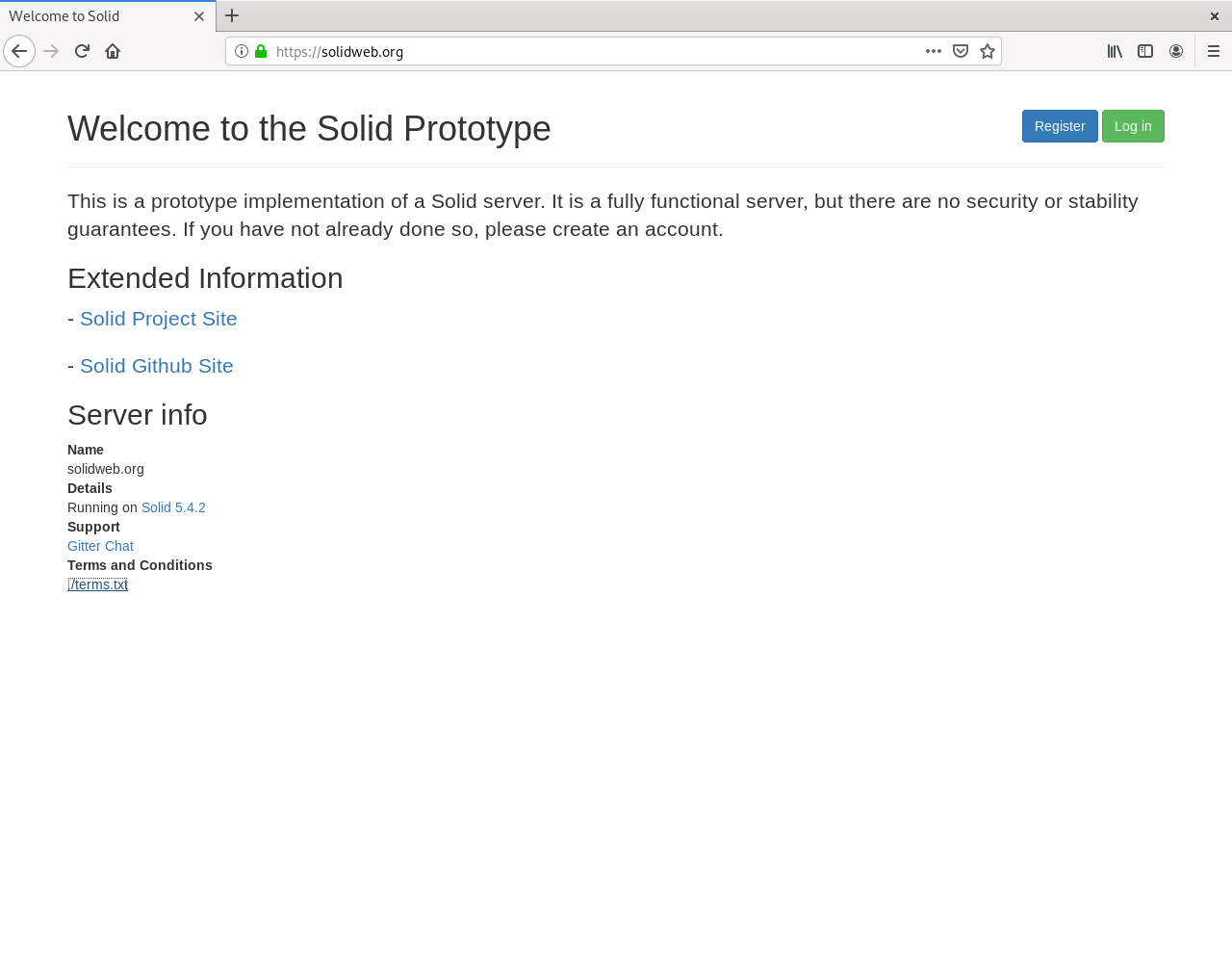
solidweb.org
certbot)$ solid init
* ? Path to the folder you want to serve. Default is (./data) /var/www/html/data
? SSL port to run on. Default is (8443) 8443
? Solid server uri (with protocol, hostname and port) https://solidweb.org
? Enable WebID authentication Yes
? Serve Solid on URL path /
? Path to the config directory (for example: /etc/solid-server) (./config) /var/www/html/config
? Path to the config file (for example: ./config.json) (./config.json) /var/www/html/config.json
? Path to the server metadata db directory (for users/apps etc) (./.db) /var/www/html/.db
? Path to the SSL private key in PEM format /etc/letsencrypt/archive/solidweb.org/privkey1.pem
? Path to the SSL certificate key in PEM format /etc/letsencrypt/archive/solidweb.org/fullchain1.pem
? Enable multi-user mode Yes
? Do you want to set up an email service (y/N) N
? A name for your server (not required) solidweb.org
? A description of your server (not requred) undefined
? A logo (not required) undefined
? Do you want to enforce Terms & Conditions for your service (y/N) N
? Do you want to disable password strength checking (y/N) N
? The support email you provide for your users (not required) meisdata@gmail.com
config created on /root/config.json
"useEmail": true, "email": { "host": "smtp.sendgrid.net", "port": "465", "sender": "me@evering.eu", "secure": true, "auth": { "user": "apikey", "pass": "xxxxxx" } }
[Unit]
Description=solid - Social Linked Data
Documentation=https://solid.inrupt.com/docs/
After=network.target

[Service]
Type=simple
User=solid
WorkingDirectory=/var/www/html
ExecStart=/usr/bin/solid start
Restart=on-failure

[Install]
WantedBy=multi-user.target
# Nginx configuration for Solid on Port 8443

## Redirects all HTTP traffic to the HTTPS host
server {
  ## In case of conflict, either remove "default_server" from the listen line below,
  ## or delete the /etc/nginx/sites-enabled/default file.
  listen 0.0.0.0:80;
  listen [::]:80;
  server_name solidweb.org;
  server_tokens off; ## Don't show the nginx version number, a security best practice
  return 301 https://$http_host$request_uri;
  access_log  /var/log/nginx/solid_access.log;
  error_log   /var/log/nginx/solid_error.log;
}

server {
  listen *:443 ssl;
  listen [::]:443 ssl;
  server_name solidweb.org;
  server_tokens off;

  access_log  /var/log/nginx/solid_ssl_access.log;
  error_log   /var/log/nginx/solid_ssl_error.log;

ssl_certificate /etc/letsencrypt/archive/solidweb.org/fullchain1.pem;
ssl_certificate_key /etc/letsencrypt/archive/solidweb.org/privkey1.pem;

root /var/www/html; #webroot

  ## [Optional] Enable HTTP Strict Transport Security
  ## HSTS is a feature improving protection against MITM attacks
  ## For more information see: https://www.nginx.com/blog/http-strict-transport-security-hsts-and-nginx/
  add_header Strict-Transport-Security "max-age=31536000; includeSubDomains";

  location / {
    proxy_pass https://localhost:8443;

    gzip off;
    proxy_redirect off;

    ## Some requests take more than 30 seconds.
    proxy_read_timeout      300;
    proxy_connect_timeout   300;
    proxy_redirect          off;

    proxy_http_version 1.1;

    proxy_set_header    Host                $http_host;
    proxy_set_header    X-Real-IP           $remote_addr;
    proxy_set_header    X-Forwarded-Ssl     on;
    proxy_set_header    X-Forwarded-For     $proxy_add_x_forwarded_for;
    proxy_set_header    X-Forwarded-Proto   $scheme;

    proxy_set_header Upgrade $http_upgrade;
    proxy_set_header Connection "upgrade";
  }

}
@prefix dct: <http://purl.org/dc/terms/>.
@prefix pim: <http://www.w3.org/ns/pim/space#>.
@prefix solid: <http://www.w3.org/ns/solid/terms#>.

<>
  a pim:ConfigurationFile;

  dct:description "Administrative settings for the POD that the user can only read." .

</>
    solid:storageQuota "250000000" .

You are entering the world of Open Source
| item | tag |
|---|---|
| https://schema.org/ | google ontology |
| https://github.com/solid/vocab | solid vocab |
| http://prefix.cc/ | namespace lookup |
| https://lov.linkeddata.es/dataset/lov/ | linked open vocabularies |
| http://graphite.ecs.soton.ac.uk/checker/ | rdf triple checker |
| http://rdf.greggkellogg.net/distiller?command=serialize | ruby gem serializer |
—-
https://solid.github.io/understanding-linked-data/#1
—-
{
  "@context": {
    "givenName": "http://schema.org/givenName",
    "birthDate": "http://schema.org/birthDate",
    "created": "http://purl.org/dc/terms/created"
  },
  "@id": "https://example.com/users",  // <- ID of this dataset
  "created": {
        "@value": "2013-09-11T07:18:19+0000",
        "@type": "http://www.w3.org/2001/XMLSchema#dateTime"
  },
  //     ^- timestamp of when it was generated
  "@graph": [
    {
      "@id": "http://www.alice.com",
      "givenName": "Alice",
      "birthDate": "1990-01-01"
    },
    ...
  ]
}
we have an ip and a fqdn on a dedicated machine
we have cert and wildcard-cert
we have apache with a redirect-message in /var/www/html
we have nodejs amd npm
we have solid running on 8443
we have successfully created an account
we can view the hp and the card
we can’ t log in
we will continue with nginx and reverse proxy (//edit: things turned out we went with apache)
communication is mostly read and have server listed on github
all of this is a sparetime project
just like the title of this blog says since 2012
experiment and exercise
just follow your nose
 Solid Experiments