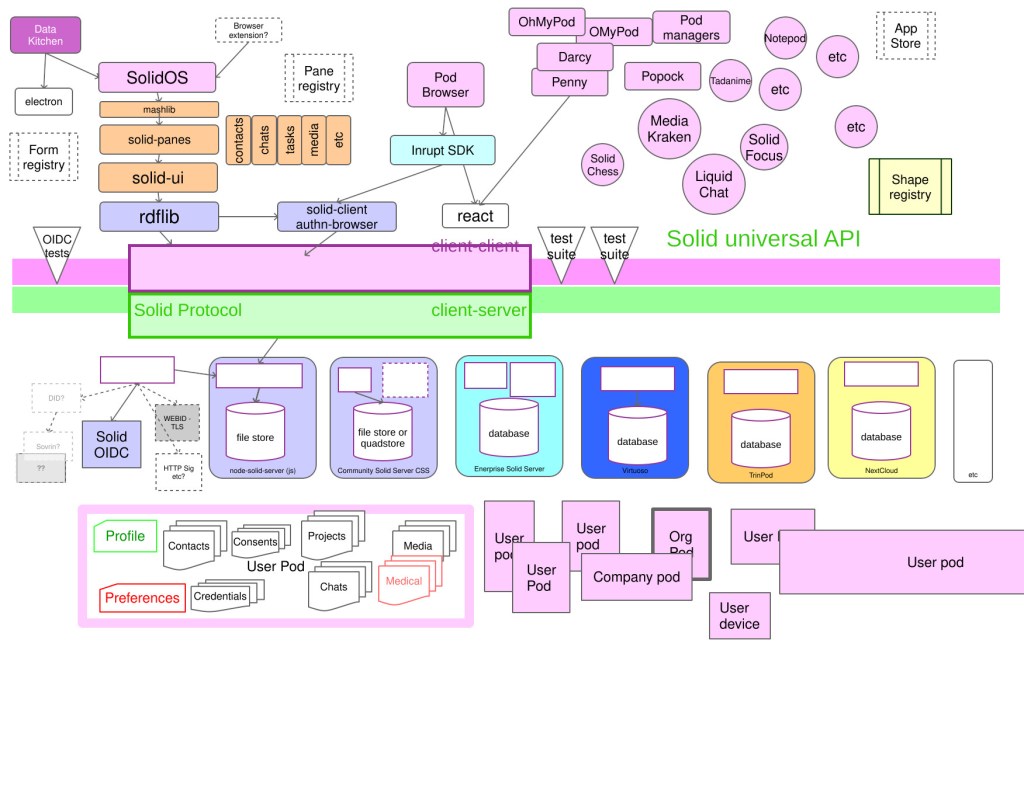
rather old, but gone public in a sleepless night
2018, I think it was the first or second day I was on Solid, Tim wrote in a chat to someone:
as you can see on your phone, I am in a plane atm and as I can see on my phone, you are at a supermarket atm.
now we have 2026, age of LLMs.
can imagine ?
a)
when person or agent or thing x tries to discover us it follows:
b) I have created a very rough feasibility report about serving Solid behind a caddy. you will find it here: https://hackmd.io/iND5SAntQg2IYiPKF9vvkA?view
https://solidos.org/ eine SubOrg von uns
https://solidos.org/docs/ Documentation
https://solidos.org/docs/browser/ die App, die alles zusammenbringt
https://solidos.org/docs/browser/?uri=https%3A%2F%2Ftestpro.solidweb.org%2Fprofile%2Fcard%23me der Databrowser in live action
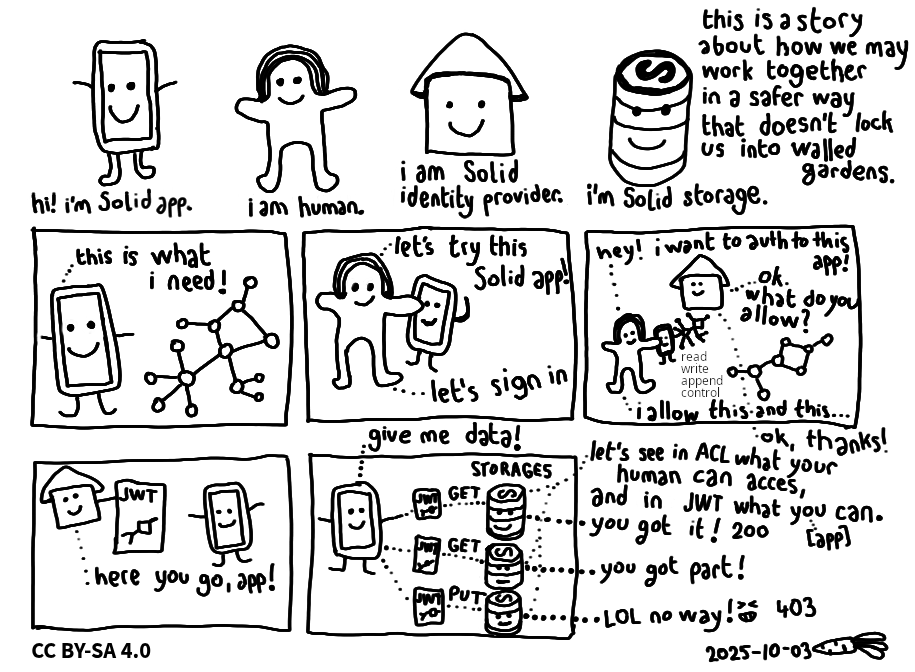
CC BY-SA 4.0 by Michal/mrkvon

The internet has revolutionized how we access information, communicate, and conduct business. However, as the web has matured, concerns about data privacy, ownership, and the centralization of power have grown. The Solid project, championed by World Wide Web inventor Sir Tim Berners-Lee, offers a radical vision for a decentralized web, empowering individuals to control their data. This article explores the history of the web, the genesis of Solid, its current status, and the transformative possibilities it presents, including the intriguing prospect of “AI Charlie” and its implications for a more semantic and user-centric internet.
The World Wide Web began as a simple system of interconnected documents, built on principles of openness and decentralization. Its early days were characterized by static HTML pages and a spirit of collaborative innovation.
In its nascent stage, the web was primarily a medium for consuming information. Websites were largely static, and user interaction was limited to clicking hyperlinks and viewing content. This era laid the foundation for the information age, making vast amounts of data accessible to a global audience.
The advent of Web 2.0 marked a significant shift towards user-generated content and interactive platforms. Social media, blogs, wikis, and online communities transformed the web into a dynamic space where users could not only consume but also create and share information. Companies like Facebook, Google, and Amazon rose to prominence by building centralized platforms that aggregated user data, offering convenient services in exchange for personal information. This era, while immensely beneficial in fostering global connectivity, also brought about concerns regarding data privacy, algorithmic manipulation, and the immense power wielded by a few tech giants. The current landscape is dominated by these centralized entities, leading to what some describe as a “splinternet” where user data is siloed and controlled by corporations.
Sir Tim Berners-Lee, the visionary who gave us the World Wide Web, became increasingly concerned about the direction the web was taking. He envisioned a web where individuals, not corporations, owned and controlled their data. This concern led to the inception of the Solid project.
Solid, an acronym for “Social Linked Data,” was born out of Berners-Lee’s frustration with the centralized nature of Web 2.0. He saw a need to return to the web’s original principles of decentralization, openness, and user empowerment. The project officially began at MIT in 2015, with the goal of creating a platform that would allow users to store their data in personal online data stores (PODs) and grant applications permission to access specific pieces of that data.
At its core, Solid proposes a fundamental shift in how data is managed on the internet.
The initial stages of Solid involved developing the core specifications, protocols, and reference implementations. This included defining how PODs would function, how applications would interact with them, and how data would be structured using Semantic Web technologies. Early adopters and developers began experimenting with Solid, building prototypes and testing its capabilities. The project has seen continuous development and refinement, with contributions from a growing community of developers and researchers.
The Solid project has matured significantly since its inception and is now moving towards production-ready status. This involves not only refining the technical specifications but also building a robust ecosystem of applications and services.
Solid’s core specifications are stable, and several implementations of Solid servers (POD providers) and client libraries are available. The community is actively working on improving developer tooling, documentation, and user experience.
A growing number of organizations and individuals are offering Solid POD hosting services. These range from self-hosted solutions for technically inclined users to managed services that simplify the process of setting up and maintaining a POD. This diversity ensures that users have options for where they store their data, promoting decentralization and resilience.
Developers are increasingly building applications that leverage the Solid platform. These “Solid Apps” are designed to interact with users’ PODs, providing services without requiring users to hand over their data to the application provider. Examples include:
While Solid offers compelling benefits, its widespread adoption faces several challenges.
The successful implementation and widespread adoption of Solid promise a transformative shift in the internet landscape, offering significant benefits for individuals, developers, and society as a whole.
The most profound benefit of Solid is the return of data ownership to the individual. Users gain complete control over their personal information, deciding where it’s stored and who can access it. This empowers individuals to make informed choices about their privacy and reduces the risk of data breaches and misuse by large corporations. It shifts the power dynamic from platforms to people.
By leveraging Semantic Web principles, Solid fosters unprecedented interoperability. Data stored in a POD can be understood and utilized by any Solid-compatible application, regardless of its developer. This eliminates data silos and encourages innovation, as developers can focus on building powerful applications without having to worry about data ownership or compatibility issues with other platforms. New applications can easily integrate with existing data, leading to richer and more personalized experiences.
Solid breaks down the barriers to entry for new applications and services. Developers no longer need to build massive data infrastructure or rely on proprietary APIs. This fosters a more competitive and diverse ecosystem, where smaller teams and independent developers can create innovative solutions without being beholden to tech giants. This can lead to a resurgence of creativity and a wider array of choices for users.
A decentralized web is inherently more resilient. Data is not stored in a single, vulnerable location, making it less susceptible to outages, attacks, or censorship. If one POD provider goes offline, a user can simply move their POD to another provider, retaining full access to their data. This distributed nature enhances the stability and freedom of information on the internet.
With full control over their data, users can enable highly personalized experiences without sacrificing privacy. Applications can access specific data points (with explicit permission) to offer tailored recommendations, services, and content that are truly relevant to the individual. This moves beyond the generalized, often intrusive, personalization offered by current platforms.
Imagine an artificial intelligence agent, not controlled by a single corporation, but rather existing as a personal, intelligent assistant that draws its knowledge and capabilities from your own Solid POD. This is the intriguing concept of “AI Charlie.”
“AI Charlie” represents a hypothetical, personal AI that resides within or interacts directly with an individual’s Solid POD. Unlike current AI assistants that are tethered to large tech companies and learn from vast, aggregated datasets, AI Charlie would be an extension of you. It would learn from your personal data – your preferences, habits, communications, health data, and professional information – all stored securely and privately in your POD.
Solid’s architecture is perfectly suited for enabling such a personal AI:
The concept of AI Charlie pushes the boundaries of personalized computing, envisioning an AI that serves you exclusively, built on a foundation of data ownership and semantic understanding.
The Solid project represents a pivotal moment in the evolution of the internet. It is a bold and ambitious endeavor to reclaim the web’s original promise of decentralization, openness, and user empowerment. By putting individuals back in control of their data through Personal Online Data Stores and leveraging the power of the Semantic Web, Solid lays the groundwork for a more private, interoperable, and innovative digital future.
While challenges remain in terms of adoption, user experience, and the development of a thriving application ecosystem, the potential benefits are immense. Solid offers a compelling vision for an internet where data ownership is a fundamental right, where innovation flourishes unencumbered by centralized gatekeepers, and where concepts like “AI Charlie” can emerge, truly serving the individual. As we navigate an increasingly data-driven world, the principles championed by Solid offer a much-needed path towards a more equitable, resilient, and human-centric web. The journey to a decentralized web is ongoing, but Solid provides a robust framework and a beacon of hope for a better internet.
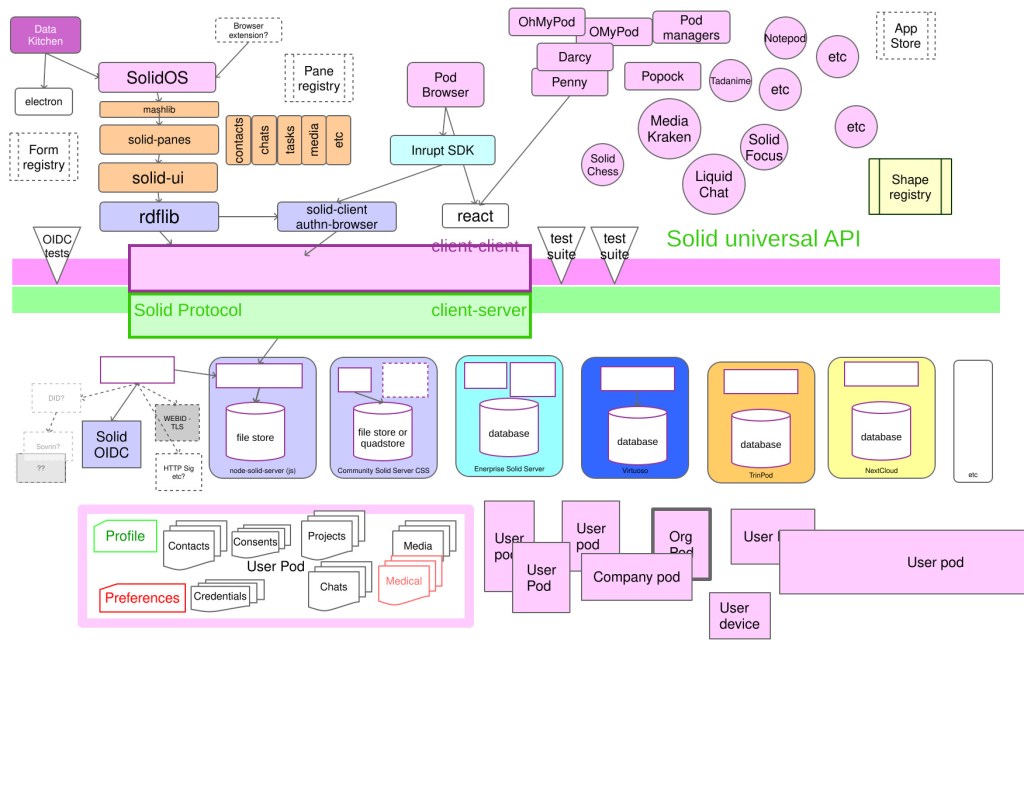
solid deitour development happens in the public.
of course, even some of our members have chosen not to make their github contributions or their participation public.
the tech is diverse. the genders are diverse. the knowledge status is diverse. the time to give is diverse. the local setups are diverse. the programming languages are diverse. the expertises are diverse. the barrier-freedom is diverse. the browsers are diverse. the debugging is diverse. the CI is diverse. the discussions are diverse. the infrastructure and the hardware are diverse. we happen to be a diverse team.
we are unified by the will to help each other. we are unified by the urge for a better web. we are unified by a common vision, that is independent of : person, status, paid work, neurodiversity, age, sex/gender, religion, conviction/philosophy, portemonnaie, provenance, handicap or physical appearance.
inclusion means that EVERYONE can participate. like in Tim’s message at the olympics. merely technically seen this means we need screenreaders, big fonts, contrast-rich UI and accessibility with mouse, keyboard, voice, whatever. but it also means we live and practice a welcoming culture and foster decision-finding processes with minimized bureaucracy and open- and wide-hearted discussions as well as include marginalized groups like the global south and east, trans- and handicapped people, implement e.g. bike- food- and shower-sharing and support like-minded organizations. there’s a hard road laid and the free world is under massive threats. let’s do our bit.
—
Matthias, https://github.com/solid/odi-governance/issues/11
are they on mastodon ?
[edit] they are. https://w3c.social/@ODIHQ@mastodon.social.
 Solid Experiments