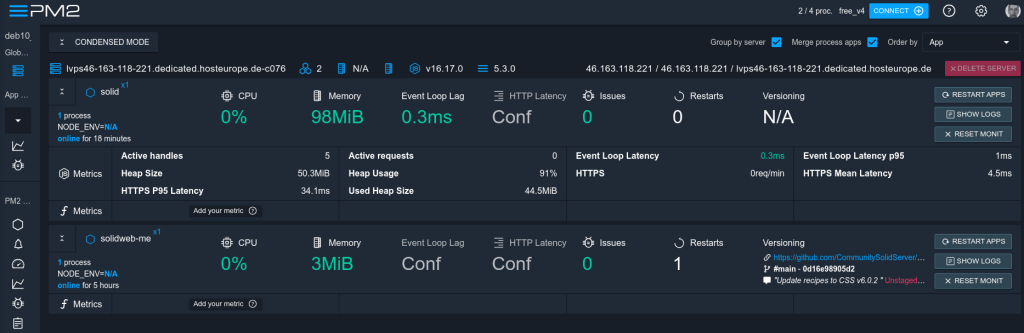
pm2


Hallo liebe Peergroups.
nachdem die Jahresendwellen sich langsam wieder etwas gelegt haben, nun etwas Eigenwerbung.
Wir (4 Administratoren) haben ein Kollektiv gegründet.
Nun habe ich 12 Jahre in einer WfbM gearbeitet und muss weitere 8 Jahre schaffen.
Da das keine echte Perspektive ist, versuche ich eine halbe Solo-/Community-/Netz-Existenz zu gründen.
Die Familie ist wohlauf und auch meine Ex-Krebserkrankung hat sich in Luft aufgelöst.
Mein Home sind 17 Leute und behandelnde Professionelle gibt es mehr als genug.
Wir arbeiten daran, die Data-Silos überflüssig zu machen und den Usern (uns allen) die Rechte an ihren eigenen Daten zurückzugeben.
Wenn Du/Sie/Ihr also einen Fünfer für Datensicherheit und -souveränität übrighabt, bitte ich Euch, unter nachgenannter URL einen kleinen Obulus zu spenden.
Dies ist kein Ewing-Versorgungslink sondern für einen Server, der etwas mehr Netzgerechtigkeit schafft.
Bürokratische Hindernisse gibt es noch einige, aber die werden getacklet.
Seht Euch https://opencollective.com/meisdata/projects/teamid an.
Dear peergroups.
now, after the years-end-eruptions have vanished, now a bit of advertising.
We (4 Admins) have founded an open collective.
I have worked 12 years in a print-office and have further 8 years to go.
Because this is no real perspective, where one can build a house on, I try to found a Solopreneur-/Community-/Web-existance.
The family is fine and healthy and the cancer is gone forever (thank God).
I live together with 16 people and Docs/Staff is around more than necessary.
We are trying to make the Data-Silos obsolete and to empower the Users (us all) and give them back the rights over their data.
This is not personal/egocentric but helps to flip the web right-side-up.
So if you can afford a fiver for data safety I ask you politely to donate a small amount under following URL.
There are still some bureaucratic hurdles but they are being tackled.
Have a look at https://opencollective.com/meisdata/projects/teamid .
Introduction
This document provides an overview of Solid, a framework designed to enhance data management on the web. Solid introduces a method for users to store and control their data separately from the applications they use.
Overview of Solid
*Data Management with Solid*
Solid enables users to store their personal data in online data stores, known as Pods. These Pods are controlled entirely by the user, who can grant or revoke access to applications as desired. This separation of data from applications allows for greater user autonomy over their personal information.
*Solid’s Technical Approach*
The technical foundation of Solid is based on principles of Social Linked Data (SoLiD), facilitating the interconnectivity of data across different platforms and applications. The emphasis is on data portability and interoperability within a secure framework.
Concept of a Web Operating System
*Solid’s Role*
While Solid contributes to the broader idea of a web-based operating system by enabling the modular use of web applications, the focus remains on its function as a data management framework. The notion of a web operating system is a broader concept, one of many potential applications of the Solid protocol.
*Application Diversity and User Choice*
Solid encourages a diverse ecosystem of client-side applications. This variety provides users with the flexibility to choose applications based on their specific needs and preferences, without being limited by data storage constraints.
Security and Privacy in Solid
*Data Control and Privacy*
One of Solid’s key features is its emphasis on user-controlled data privacy. Users have the authority to manage who can access their data, enhancing privacy and data security on the web.
Solid in the Web Ecosystem
*Integration with the Web*
Solid is designed to function within the existing web ecosystem, complementing and enhancing current web standards. Its focus is on user data management rather than redefining the web infrastructure.
Conclusion
Solid represents a structured approach to data management on the web. It provides a framework for user-controlled data storage and application interoperability, contributing to the development of a more user-centric web experience.
© Melvin Carvalho 2023-11-23
: —- thumbsup —- :
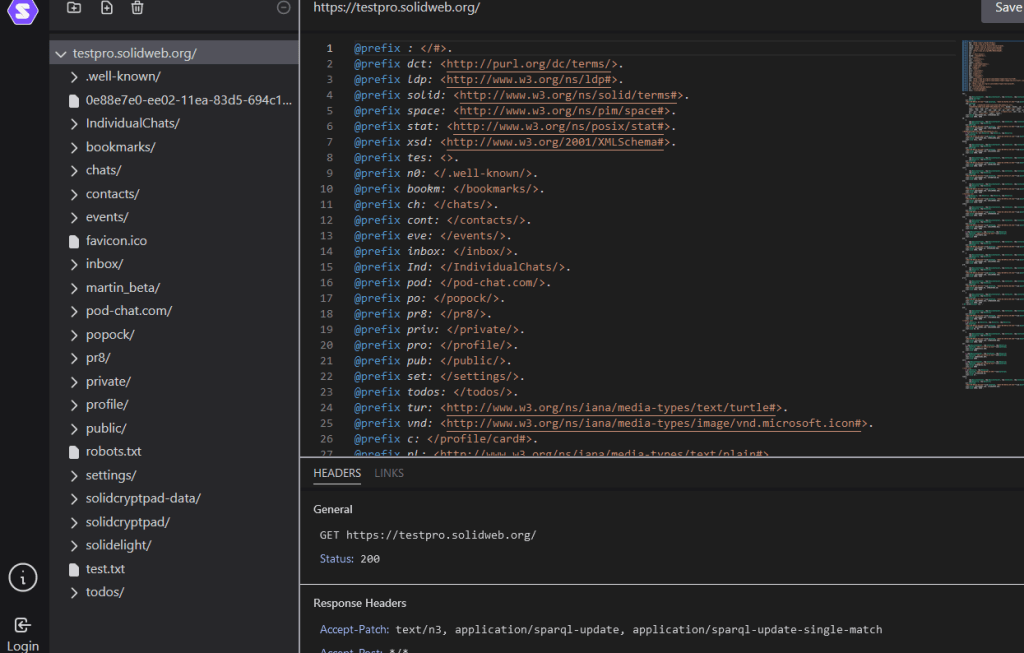
@prefix foaf: <http://xmlns.com/foaf/0.1/>.
@prefix solid: <http://www.w3.org/ns/solid/terms#>.
<https://example.com/profile/card#me>
a foaf:Person ;
foaf:name "John Doe" ;
foaf:givenName "John" ;
foaf:familyName "Doe" ;
foaf:email <mailto:john.doe@example.com> ;
solid:publicTypeIndex <https://example.com/publicTypeIndex.ttl> ;
solid:privateTypeIndex <https://example.com/privateTypeIndex.ttl> ;
solid:storage <https://example.com/> .

Let’s try one in another language. The Weekend seems to be a bandname, and ours are usually empty and we have only a local food supplier and then the solitary confinement of the room. Urge Overkill appears. The community backens up the development. Rehab is over and we need new tasks. Most of the TV is just bullshit, yes we followed the Red Hot Chili Peppers. Nevertheless we have memories. As grassroots movement we have a gazillion issues we have to take care of. AuthN, authZ, the login, the UI/UX, storage, linking, terms, ontologies, the workgroups, appdev and so on. Most of the work happens in the public. We have meetings everyone is invited to. Contributions of code are mostly more than welcome. We are organized in a community group that is on the edge of being transformed into an official W3C working group. Our captain has a hands-on mentality. When visiting Amsterdam in the late eighties, we even dreamt in english. Most of the time we feel familiar with thinking in the number one tech language of the landscape. Abbrevations and buzzwords are sometimes not helpful. But we get used to them.
“Dead Moon – Over the Edge” is lurking under the bed. Dedicated our life and work to Solid and positivity we try to get along not harming anyone. Heretics is a well-known concept and we always (as long as we can think) have to cope with the monster of negativity. Satellites, brothers, sisters, mood coordination, loneliness, isolation, the system we try to change, revolutionary ideas, code, human features and the survival of our species and the planet, considerations of pain management are accompanying us for years. We never even thought a single second of giving up. The nodes of our brains and consciousness are loosely coupled with each other and with a life that’s worth it. None of it was in vain. Dreams, for sure. The books and films, the experiences and processes we went through made us who we are. Will we succeed ? Let’s give the damned life inside job a shot. Otherwise we will never know what would have happened, how we can improve, who is a friend, live and work an autonomous life. Their job is to make themselves obsolete.
The eyes of the world they are watching out. Remember Steve Biko.
Belgien im Allgemeinen, Flandern im Besonderen ist ein Epizentrum des Projekts “Solid”. Dort sollen 6 Millionen Pods an die Bürger ausgerollt werden. Ein Pod ist ein Personal Datastore, ein Stück des Webs, ein Datentopf, den man sich wie einen Ftp-Server vorstellen kann. Ein Pod kann jedoch weit mehr, als lediglich Daten zu hosten. Persönliche, Business-, Bank- oder gar Heizungsdaten werden bereitgestellt und sind semantisch verknüpft mit anderen Daten aus anderen Quellen, also verlinkt. Mehrere Anwendungen können auf dieselben Daten zugreifen, userzentriert sind alle Daten im ursprünglichen Sinne Eigentum des Besitzers. Metadaten sind ein wichtiger Bestandteil – Stichwort “see also” – und die Zeiten der Blogosphere sie leben hoch. Ein weiterer, wenn man so will ein siebter, Layer des Webs wird eingeführt, on top of everything that exists today. Die Identität des Users ist ein simpler URL, weltweit einmalig, und sie sichert den Zugang zum gesamten Ecosystem. Vergessen Sie 70 Logins bei 70 verschiedenen Onlineshops, Sie geben Ihre persönlichen Daten einmal ein und gewähren lediglich – wem auch immer, Personen, Organisationen oder Anwendungen – Zugang zu Ihrem Pod, den Sie jederzeit rückgängig machen können, also wieder entziehen. Verschiedene Apps konkurrieren miteinander und wenn App B ihren Job besser macht als App A, dann wechseln Sie lediglich die Rechte, die Sie gewähren. Bereits heute gibt es einige Handvoll Pod-Provider.
Erfunden hat’s, wie sollte es auch anders sein, Tim Berners-Lee auch genannt timbl und das ganze Projekt enstammt einem Forschungsprojekt am Massachuchetts Institute of Technology. Die Community ist global, kommt also aus allen Ecken des Planeten und arbeitet hart am Kernstück unter dem Dach des W3C, den Specifications. Terms, Ontologien, Vocabularies, Prozesse, Fehlermeldungen, Authentifikation und Autorisation sind erfunden worden und greifen bis ins letzte Detail ineinander. Im Wesentlichen gibt es bereits heute drei Versionen des Servers, die Produktionsreife erreicht haben, oder mindestens anstreben und die als Open Source jedermann zugängig sind. Der Quellcode ist in Javascript und Typescript geschrieben und wird in einem Github-Repository bereitgestellt. Stellen Sie sich vor, Sie brauchen nie wieder verschiedene Logins und Sie müssen nicht bei jeder neuen App wieder und wieder Ihre persönlichen Daten in ein Formular eintragen und sich dutzende (wenn nicht mehr) Passwörter merken. Manche nennen es Web 3.0. Mindestens auf der Transportschicht ist alles verschlüsselt. Die Blockchain brauchen Sie nicht dafür. Ein Haus hat verschiedene Zimmer mit verschiedenen Graden der Privatsphäre. Alice und Bob können kommunizieren, veröffentlichen, liken ohne dass Big Brother darin eingreifen kann. Denken Sie an die A.I. als Charlie. Das Web, wie es ursprünglich gedacht war, nimmt Formen an. Eine offizielle 1.0 gibt es noch nicht. Das ist jedoch lediglich eine Frage der Zeit. Sehen Sie sich um.
Spannende Zeiten.
Welcome to the world of Solid.
here we provide Links, Entrypoints and Deepdives.